+44 7933 142807
 info@nursingessaywriter.co.uk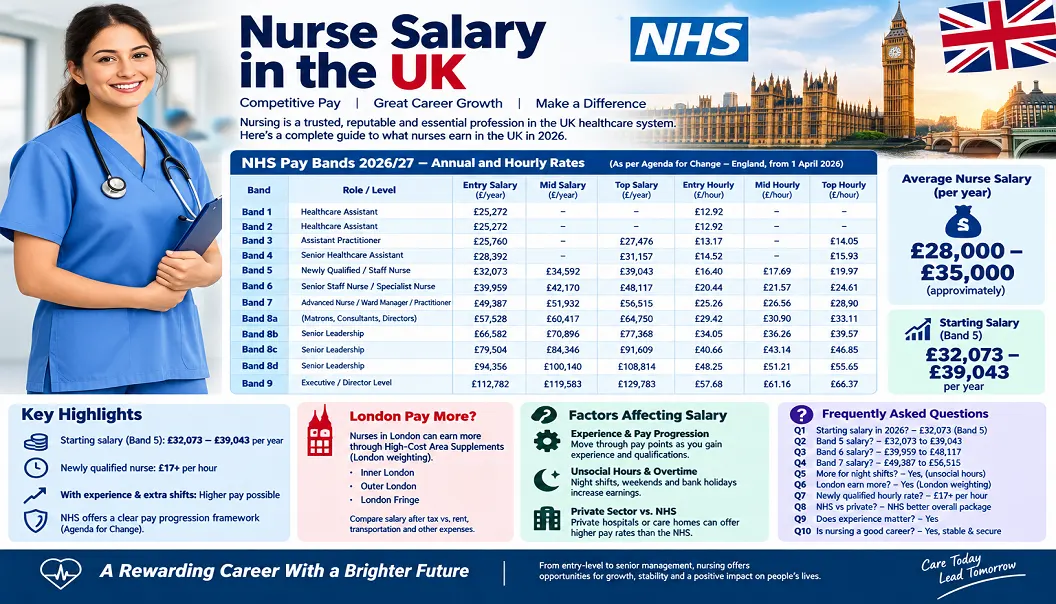
In the UK, the field of nursing is one of the most trusted, reputable, and essential professions. From caring for patients in busy emergency departments to supporting people through long-term illnesses, nursing plays a crucial role in the UK healthcare system.
Despite the profession being rewarding, salaries remain an important factor due to the rising living costs and changing economic conditions. So what's the nurse salary in the UK in 2026?
Mostly, nurses in the UK work under the National Health Service, also known as the NHS, where pay is set by a national framework called Agenda for Change (AfC). However, in the London region and in the private sector, the pay structure is a bit different.
According to the NHS Agenda for Change system, nurses are placed into different pay bands according to their responsibilities, qualifications, experience, and level of expertise. Newly qualified nurses begin at Band 5; experienced nurses, advanced practitioners, and senior healthcare leaders may progress into higher bands. The base salary of an average registered nurse in the UK can range from £31,000 to £45,000 (it all depends on banding and experience)
Let's learn more about how nursing salaries work in the UK.
What Are NHS Nurse Salary & Agenda For Change Pay Bands?
The NHS uses the Agenda for Change system to determine the salary structures for thousands of healthcare employees. It provides a clear framework so that nursing employees can easily know where they stand and how they can progress, instead of employees continuously negotiating their salaries. Moreover, roles are placed into specific bands based on their level of responsibility and professional requirements.
For newly qualified registered nurses in the UK, band 5 is the starting point, and as they gain experience or skills or move to advanced practice or management roles, they can progress towards band 6, 7 and beyond.
NHS Pay Bands 2026/27: Annual and Hourly Rates
As per the NHS, these are the basic-pay rates applied in England from 1 April 2026.
|
NHS band |
Entry salary |
Mid-salary |
Top salary |
Entry hourly |
Mid-hourly |
Top hourly |
|
Band 1 |
£25,272 |
— |
— |
£12.92 |
— |
— |
|
Band 2 |
£25,272 |
— |
— |
£12.92 |
— |
— |
|
Band 3 |
£25,760 |
— |
£27,476 |
£13.17 |
— |
£14.05 |
|
Band 4 |
£28,392 |
— |
£31,157 |
£14.52 |
— |
£15.93 |
|
Band 5 (Newly Qualified / Staff Nurse) |
£32,073 |
£34,592 |
£39,043 |
£16.40 |
£17.69 |
£19.97 |
|
Band 6 (Senior Staff Nurse / Specialist Nurse) |
£39,959 |
£42,170 |
£48,117 |
£20.44 |
£21.57 |
£24.61 |
|
Band 7 (Advanced Nurse / Ward Manager / Practitioner) |
£49,387 |
£51,932 |
£56,515 |
£25.26 |
£26.56 |
£28.90 |
|
(Matrons, Consultants, Directors) Band 8a |
£57,528 |
£60,417 |
£64,750 |
£29.42 |
£30.90 |
£33.11 |
|
Band 8b |
£66,582 |
£70,896 |
£77,368 |
£34.05 |
£36.26 |
£39.57 |
|
Band 8c |
£79,504 |
£84,346 |
£91,609 |
£40.66 |
£43.14 |
£46.85 |
|
Band 8d |
£94,356 |
£100,140 |
£108,814 |
£48.25 |
£51.21 |
£55.65 |
|
Band 9 |
£112,782 |
£119,583 |
£129,783 |
£57.68 |
£61.16 |
£66.37 |
Instead of nurses remaining on the same salary, they can progress by taking on more tasks, gaining skills and qualifications, and applying for more senior positions.
What Is The Entry-Level & Newly Qualified Nurse Salary In The UK?
Band 5 is where the NHS nursing career begins for most nurses. The starting nurse salary in the UK is around £32,073, and it can increase up to £39,043. However, the actual amount a nurse receives in their account is less than their gross salary, and this is due to the deductions of income tax, National Insurance, and pension contributions.
The salary of a newly qualified nurse is £17+ per hour. However, the next hourly equivalent depends on the applicable pay scale and contracted hours.
Moreover, the basic salary is not the only amount a nurse can earn. It can increase if the nurse is willing to work on nights, weekends, and bank holidays, so overtime and extra shifts can increase the overall pay.
Regional Differences: Does London Pay More?
As we all know, London is the most expensive place to live in the UK when it comes to housing and transportation; therefore, to compensate for such high costs, NHS employees working in eligible London areas can receive high-cost area supplements. This is known as 'London weighting'.
The payment depends on whether the workplace is classified as inner London, outer London, or London fringe. Moreover, as a result, a nurse working in London can earn more than a nurse on the same basic band working somewhere else in England.
Before you choose London over England, compare salary after tax against rent, transportation, and other expenses.
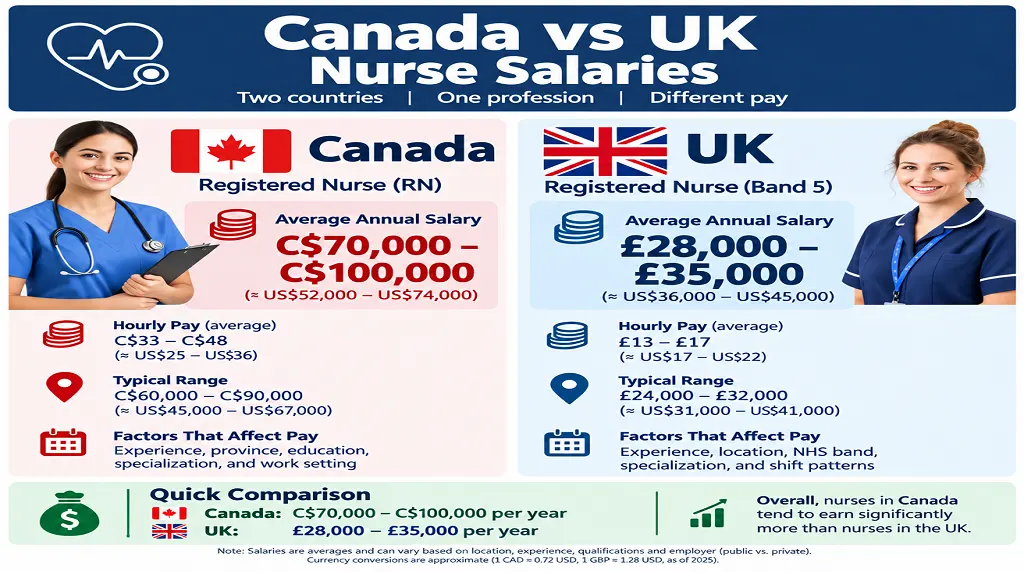
You can also compare Canada vs UK nurse salary before choosing one.
What are the Factors Affecting a Nurse's Salary In The UK?
Many factors can affect the salary of a nurse in the UK:
● Experience & Pay Progression: NHS nurses progress through their pay points as they gain experience and meet the requirements of the role. As they move within a band, their basic salary increases.
Unsocial Hours & Overtime: Working night shifts, weekends, and bank holidays also increases the salary.
Private Sector vs. NHS: As the NHS isn't the only employer of nurses in the UK, they can also work in private hospitals or care homes, where pay rates can be higher than the NHS.
Conclusion
The field of nursing in the UK is a rewarding career where growth and progression from entry-level to senior management exist. The NHS provides a clear framework for determining nurse salaries in the UK. However, the newly qualified nurse's salary starts at band 5, and their salary is around £32,073. However, with experience and skill, nurses can move beyond Band 5 to 6, 7, 8, and 9. Anyone who is planning a nursing career in the UK must understand the NHS pay band structure completely.
FAQs
Frequently Asked Questions
Q1: What is the starting salary for a nurse in the UK in 2026?
The starting salary for a newly qualified registered nurse in the UK is £32,073 per year. It is for NHS Band 5.
Q2: How much does a Band 5 nurse earn?
A Band 5 nurse earns between £32,073 and £39,043 per year in England. However, it depends on the experience level. Furthermore, through unsocial hours and overtime, one can increase their income.
Q3: How much does a band 6 nurse earn in the UK?
A band 6 nurse earns between £39,959 and £48,117 per year.
Q4: How much does a band 7 nurse earn?
A Band 7 nurse in the UK earns a base salary between £49,387 and £56,515 per year.
Q5: Do nurses get paid more for night shifts?
Nurses can boost their income by working night shifts, known as "unsocial hours" enhancements.
Q6: Do nurses in London earn more?
Yes, nurses in London earn more than nurses in the rest of the UK. This is because of the High-Cost Area Supplements (HCAS), known as London weighting.
Q7: What is the newly qualified NHS nurse salary per hour?
The salary of a newly qualified NHS nurse is £17+ per hour.
Q8: Is NHS nursing better paid than private nursing?
NHS nursing provides a much stronger overall compensation package when you include benefits.
Q9: Does experience affect a nurse's salary?
Yes, experience affects a nurse's salary in the UK through the National Health Service (NHS) Agenda for Change pay framework.
Q10: Is nursing a good career in the UK?
Nursing is a stable career in the UK with strong job security and structured pay bands, though it also involves challenging working conditions.