+44 7933 142807
 info@nursingessaywriter.co.uk
Reports play a huge role in many fields; they offer solid communication skills, delivering an organised approach and best practices to express information.
Producing reports is an obligatory skill from many perspectives, including the workplace and even the academic environment.
Quality and valuable report writing are prominent in all domains, as it pushes wise decision-making and clear communication.
By reading our articles, the readers will understand and master how to organise data and keep an objective tone. Hence, they format their findings wisely.
However, writing a report concisely and clearly needs plenty of time. You have to perform a lot of research, and you must figure out precisely what your audience wishes to understand to ensure you are writing pertinent information.
While there is no single fixed template for every report, understanding the core structure will make the process much simpler. and uses a different structure. But do not worry; I have all of the solutions that solve your problems.
Let’s begin the guide.
What Is Report Writing? (Foundational Clarification)
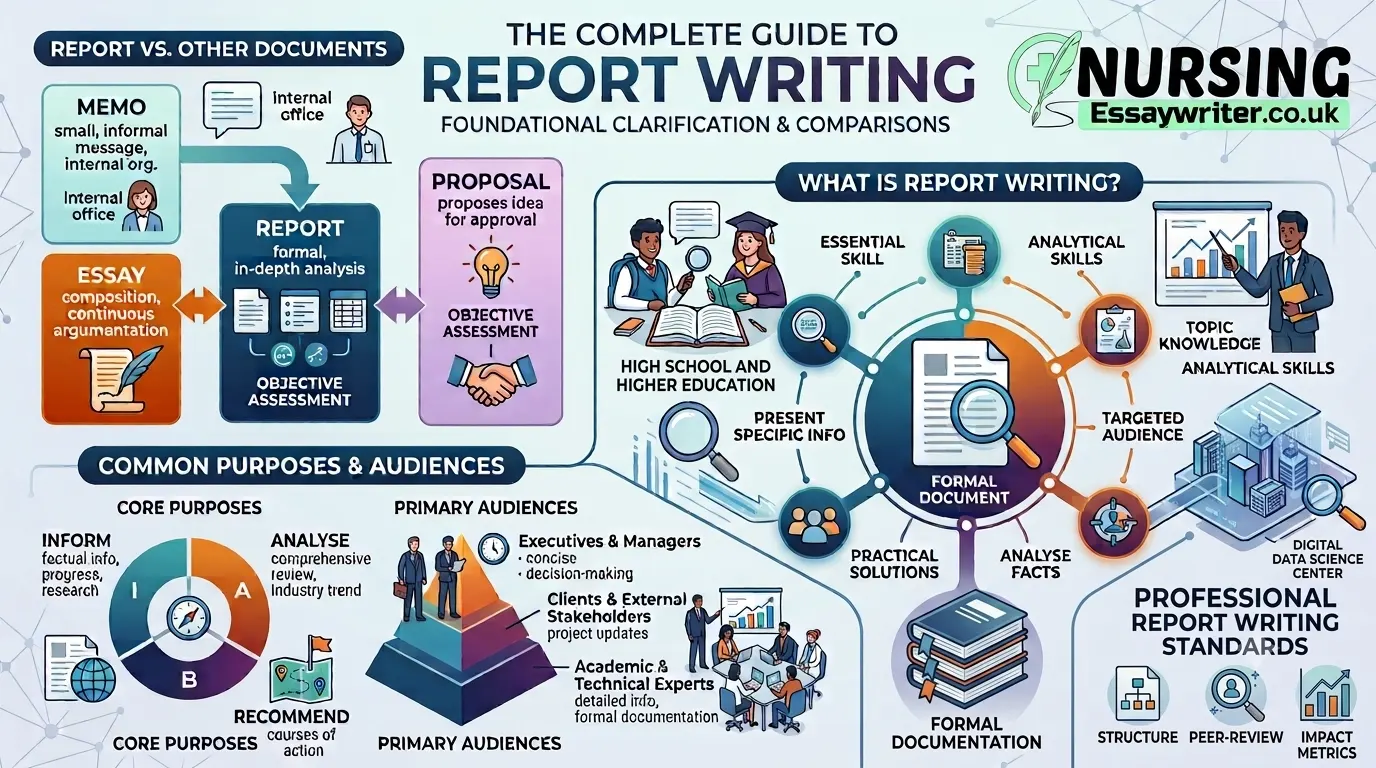
Learning how to write a report is an essential skill. It is a formal document designed to present specific information to a targeted audience.
The main purpose of a report is to analyse facts and provide practical, evidence-based solutions.
So, once you craft a report in school, college, or university, you must have a deep knowledge of the topic. Plus, you must have analytical skills in order to analyse and examine something.
Reports vs. Other Documents
Memo: A memo is a short, informal message or a note for internal communication within an organisation. While a report is a formal document providing an in-depth analysis of a specific issue.
Essay: A reflective essay is a composition that maintains a continuous development of argumentation throughout the text. On the flip side, a report uses descriptive headings, bullet points, and tables for data representation.
Proposal: Lastly, a proposal is a document that proposes a specific idea for approval. But a report objectively assesses the current state of affairs, past occurrences, or research.
Common Purposes & Audiences
Here are the common purposes and audiences of reports.
Core Purposes:
- Inform: It provides factual information, research results, or routine progress updates.
- Analyse: You have to perform a comprehensive review of a particular issue, situation, or industry trend.
- Recommend: You have to suggest appropriate courses of action for issue resolution.
Primary Audiences
- Executives and managers: Executives and managers need concise reports for timely decision-making.
- Clients and external stakeholders: Clients and external stakeholders seek informative updates on project status.
- Academic and technical experts: These experts require detailed information and formal documentation.
Types Of Reports (With Examples)
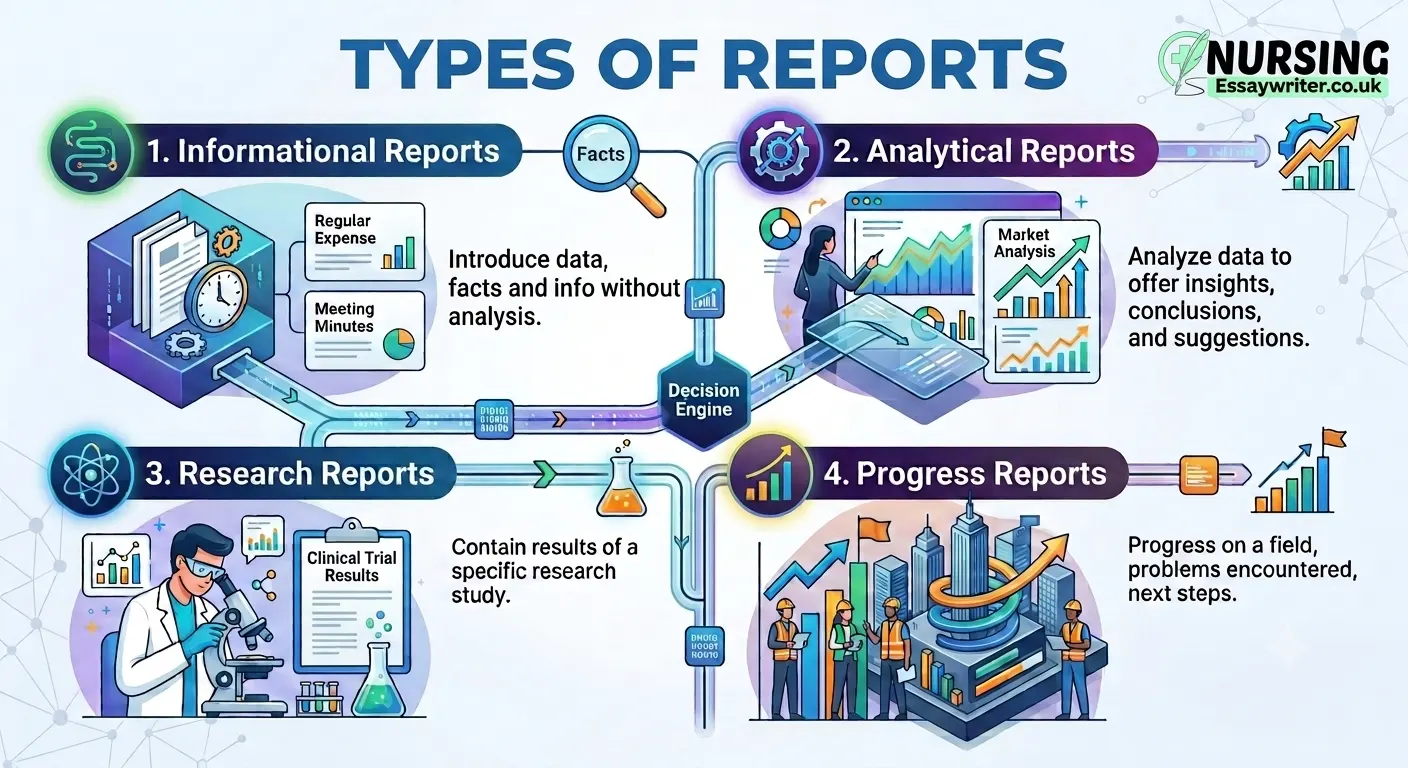
You have learned what is a report writing? In the next section, I will guide you on the different types of reports with examples.
1. Informational Reports
These informational reports introduce data, facts and info without any analysis or suggestions.
Examples: Regular expense sheets, meeting minutes, police accident logs, and compliance records.
2. Analytical Reports
Analytical reports analyse data in order to offer insights, conclusions and suggestions.
Examples: Feasibility studies (assessing whether or not to start a new product) and market analysis.
3. Research Reports
These are reports containing the results of a specific research study. The structure of a research report comprises a literature review, methodology, and analysis of the research results, among other sections.
Examples: Clinical trial results, consumer behaviour research, and academic laboratory testing
4. Progress Reports
Finally, progress reports contain information regarding progress being made in a certain field of endeavor. They also report on problems encountered and further indicate the next steps to be taken.
Examples: Software development milestone trackers or weekly construction updates
The Anatomy of A Great Report:
A decent and strong report tells a story but starts with the ending. Your stakeholders are smart people who want the bottom line first.
Use the following 4-part formula for all the findings you want to sound comprehensive yet concise.
In your report, address each issue found by
Titling The Problem
First of all, you have to write a title for your report that your stakeholders will remember
Example of a strong title: Bad Issue #3 Good: The Invisible Checkout Button
Stating The Evidence
You have to mention the evidence, like one quote or video clip + one key metric.
Example: I kept looking for a way to pay, but I could not find it," said P4. 70% of participants could not find the checkout button on their first attempt.
Writing The Insight
Now, write the one sentence that explains the evidence.
The checkout button was hidden in the footer, violating standard UI/UX expectations of having prominent top-level actions at the top of the page
Providing a Recommendation
In the final step, you have to offer a recommendation like something specific that the team can do.
After that, move the checkout button to the bottom navigation bar as a permanent icon and make it more prominent by using a distinctive colour.
Need Help Structuring Your Nursing Report?
Writing an academic or clinical report can be challenging. Our professional nursing report writers in the UK are here to guide you through research, formatting, and critical analysis. Get Expert Assistance Today!
Let’s Connect!
How To Write a Report: Step-By-Step Process?
Here are the key steps of producing a strong and valuable report.
1. Define Purpose
To produce a superior report, first of all, you must define its aims. So, you have to think about the intent of report writing in the UK. It is informing, persuading, or analysing.
As a result, by aligning and supporting your purpose and fulfilling the needs of a project or assignment, you will make sure it provides pertinent and key information.
2. Understand Your Audiences
Before you write your report, you must grasp and learn your target audience. It is obligatory to adopt the tone and level of detail of your report content.
For instance, an executive leadership report might emphasise top-level findings. Whereas for a marketing team, a report can go deeper into particular details and analysis.
3. Gather & Access Evidence
You have to dig deeper and then collect evidence from various reliable sources. The whole complexity of your research will wholly rely on the goal you drafted and the kind of report you write.
But before you begin collecting sources, you have to learn what kind of report writing you need to do.
Among the most frequently cited reports, sources are defined in the following section.
Internal Reports: Weekly project status, sales, business statistics, CRM exports, analytics dashboards, and team feedback are examples of internal reports.
Industry Publications: It contains financial statistics, market research, and internal performance reports.
Peer Reviewed Studies: Lastly, include official data, scholarly publications, and verifiable figures from reputable sources.
4. Create An Outline
Now, draw an outline; your outline is your roadmap for your readers. A good outline is easily followed, and your readers will have no problem reading what you write.
For instance, typical UK report writing comprises an executive summary, introduction, body, conclusion, and references.
5. First Draft Clearly & Concisely
After developing an outline, the next step is to write the first draft of your report. Keep in mind that your first draft does not need to be perfect. Focus on getting your ideas down clearly first, and refine them during the editing phase.
However, editing is not your priority at the moment; your goal is to write a first draft that conveys your message clearly and concisely.
6. Edit For Accuracy & Flow
So, after you have finished writing, you need to revise your work; ideally, you should do it two or three times, and a good time to do it would be the following day. This will allow you to catch any minor errors, omissions, or grammar and spelling problems in your work.
7. Finalize It
Finally, make sure to double-check everything before submitting the final version of your paper. In addition, it should be free of any plagiarism since it has to be entirely original.
Moreover, you need to ensure that you have followed all of your tutor’s requirements and that your report’s citations are correctly formatted inHarvard, OSCOLA, or APA styles.
Tools & Templates To Speed Up Report Writing
After completing my research, I discovered several report writing tips and tools that can significantly speed up the process. So, here are some report writing tips and tools that can assist you in completing your task.
To save time on design and organisation, consider using Word, Google Docs, or Canva report templates.
AI Assistants: To get help brainstorming ideas, writing, outlining, and summarising, you can use programmes such as Microsoft Copilot or ChatGPT.
Editing Software: To assist in detecting typos and improving your language’s overall quality, you can use Grammarly
Data & Research Managers: To help organise your thoughts and create charts or graphs, you can use such programs as Notion or Visme.
Winding It Up:
Therefore, with these helpful tips on report writing, I believe that you are now well-equipped to learn how to write a report correctly. When you are writing a report, you must strive to offer quality information in a professional manner.
In addition to that, you have to keep the following points in mind: purpose, audience, evidence, and organisation.
In general, you need to apply all of the aforementioned report writing suggestions and guidelines to compose a high-quality report that will meet your supervisor’s expectations successfully.
Frequently Asked Questions
Q1: What is the main difference between a report and an essay?
Unlike essays, reports are not written as extended pieces of writing; they use headings, bullet points, and tables to present information more objectively.
Q2: What are the 4 types of reports?
There are 4 different types of reports comprising informational reports, analytical reports, research reports, and progress reports.
Q3: What is a 4-part formula for reporting a finding?
Every piece of information discovered should be arranged in a 4-part format that comprises title, evidence, insight, and recommendation.
Q4: What tone can I use when writing a report?
When you are writing a report, you should apply objective, factual, precise, and professional language tailored to the target audience.
Q5: What Tools can I use in reports that make it easier and faster?
There are a lot of helpful tools for writing a report, including Copilot or ChatGPT, Grammarly, and Notion or Visme.